In a city corner where tension hung in the air, a line of police officers in riot gear stood steadfast, shields raised, their faces obscured by helmets. Across from them, the streets hummed with uncertainty, whispers of protest carried on the wind. Amongst the movement, a single figure stood out—a young boy, no older than ten, with arms full of water bottles. His small frame seemed dwarfed by the enormity of the scene around him, but his actions spoke louder than the chaos.
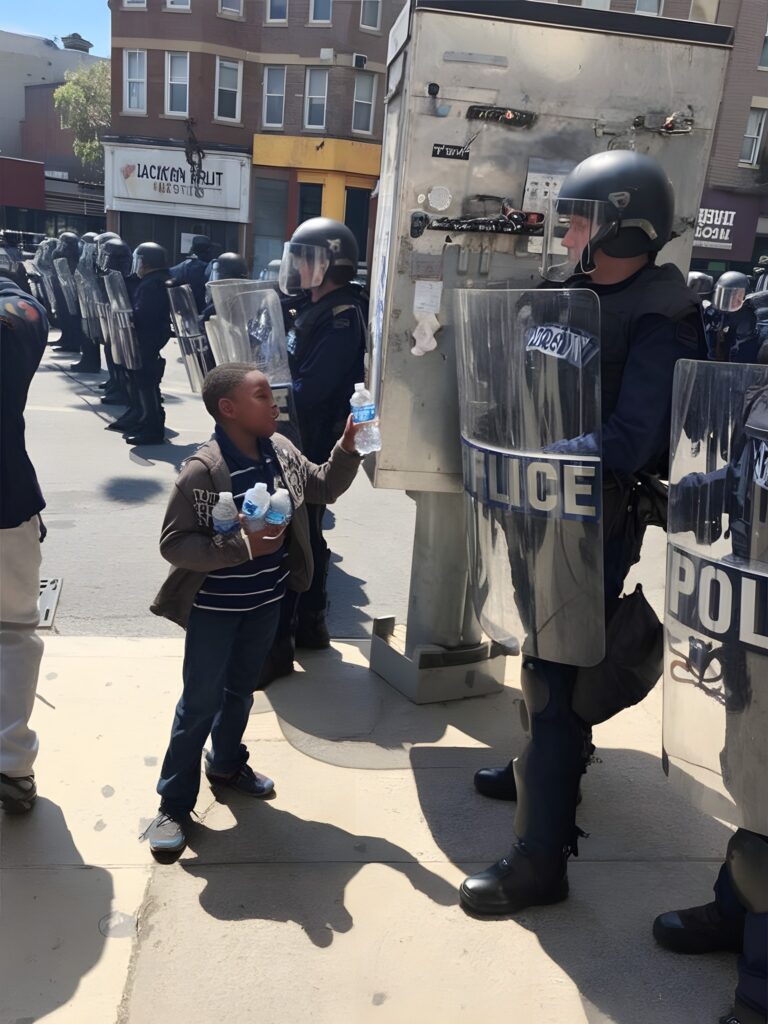
With quiet determination, the boy stepped forward, his eyes scanning the line of officers. Despite their imposing presence, his steps did not falter. He approached one of the officers—a man hidden behind a shield marked “POLICE,” his face unreadable behind a plastic visor. For a moment, everything seemed to pause. The boy extended a water bottle toward the officer, his gesture simple but profound.
The officer hesitated, glancing down at the boy’s outstretched hand. The crowd around them held its breath, watching this unexpected moment unfold. Then, in a silent exchange of understanding, the officer accepted the bottle. He lowered his shield slightly, just enough for their eyes to meet. There were no words, but the gesture itself spoke volumes.
In that moment, the division between them—authority and civilian, adult and child—blurred. What was once a standoff became a shared moment of humanity. The boy, offering kindness in a time of uncertainty, and the officer, accepting it, created a brief but powerful connection. The crowd seemed to soften as they watched, and for just a moment, there was peace.
As the boy moved on, distributing more bottles to the line of officers, the message was clear: sometimes, even in the midst of tension, the simplest acts of kindness can bridge the deepest divides.