Agnes Fletcher had lived on her family’s farm for over 80 years, her hands weathered from decades of tending the land, her heart rooted deep in the soil. The farm had been passed down through generations, a symbol of hard work, perseverance, and independence. Her father always told her, “Agnes, the land is life. As long as we hold it, we hold our future.”
In recent years, however, things had begun to change. Rumors spread through the town that foreign buyers were purchasing farmland across the state—huge corporations from China, offering sums that struggling farmers found hard to refuse. Agnes had seen the impact on her neighbors: once independent farms were now part of conglomerates, run by strangers who cared little about the community or the history of the land they were acquiring.
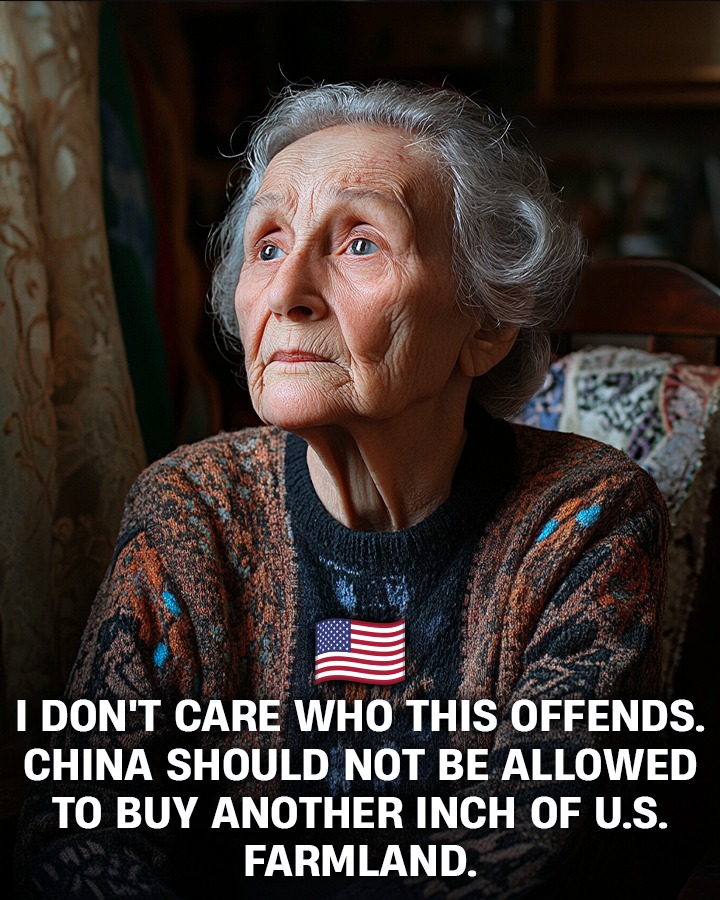
The thought troubled her. Agnes had spent a lifetime defending this land from droughts, floods, and market downturns. She’d fought to keep it alive for her children and grandchildren. But this new threat, this silent takeover by foreign interests, was something different. It felt like a betrayal.
One evening, Agnes sat at the kitchen table, her knitting in hand, staring out the window at the fields that stretched into the horizon. The sunset bathed the land in a golden light, and she remembered the stories her father had told her about the land’s significance, its connection to their family and the nation itself. “The land feeds us,” he’d say. “It’s not just dirt; it’s our security.”
Agnes had no plans of selling her land, but the pressure was mounting in the region. Neighbors were being offered deals too good to refuse. “It’s just business,” they said. But Agnes didn’t see it that way. To her, selling to a foreign power meant losing something much greater—control over the future. Once the land was gone, what would be left for the next generation?
Determined, she became a voice in the community, speaking out at town meetings and rallies. Some called her old-fashioned, others called her brave. But to Agnes, it didn’t matter what they thought. She was not going to allow another inch of farmland to be sold off to foreign buyers, especially not to those with interests that seemed far from protecting the American heartland.
In her speeches, Agnes would say, “This isn’t about money, it’s about our sovereignty, our food, our future. If we lose control of our land, we lose control of our destiny.” The message resonated with many, especially younger farmers who were just starting out, and soon her movement gained momentum.
Agnes, with her wrinkled face and soft-spoken demeanor, became a symbol of resistance. People from neighboring towns and states started to take notice. Her campaign wasn’t just about keeping foreign interests at bay—it was about reigniting pride in local farming, in the idea that the land was something sacred.
She knew the battle wasn’t going to be easy. But as she gazed out across the fields that had sustained her family for generations, Agnes felt a deep sense of purpose. She was fighting not just for her land, but for the future of the nation’s farmland as a whole.
And as long as she had breath, she would continue to fight.